

Contents
- 1 How Is PRP Prepared?
- 2 1. Dedicated PRP Collection Kit
- 3 2. Single-Use Blood Collection Needles
- 4 3. Controlled Blood Collection
- 5 4. Centrifugation – An Important Separation Step
- 6 5. PRP Quality Is Not Determined by Blood Volume Alone
- 7 6. A Controlled Workflow Helps Support Safety
- 8 PRP Safety Is More Than the Collection Kit
- 9 What Makes Oceania’s PRP Approach Different?
- 10 What Should You Check Before Having PRP?
- 11 FAQ – PRP Preparation
- 12 PRP Safety Starts With the Process
Why Does the PRP Preparation Process Matter?
When researching PRP, many clients focus mainly on potential results and overlook one of the most important questions:
How is the PRP actually collected and prepared?
Because PRP is prepared from the client’s own blood, every step—from blood collection and equipment handling to centrifugation—needs appropriate control.
A professional PRP process is not simply “drawing blood and putting it into a centrifuge.” It involves a sequence of controlled steps designed to minimize unnecessary exposure and contamination.
At Oceania Spa & Clinic, PRP is described as platelet-rich plasma prepared from the client’s own blood, combined with professional aesthetic technologies. The Ho Chi Minh City clinic also emphasizes a doctor-led model, with procedures performed by doctors rather than technicians.
How Is PRP Prepared?
The basic process can be summarized as:
Blood collection → sample processing → centrifugation → separation → PRP collection → preparation for use according to the treatment plan.
The important part is that every stage is handled appropriately.
For procedures involving autologous blood, hygiene and infection control are fundamental parts of the process.
1. Dedicated PRP Collection Kit
One factor clients should ask about is the collection and processing kit used for PRP.
At Oceania, PRP treatment follows a professional preparation process using dedicated equipment and supplies appropriate to the clinic’s protocol.
The goal is to keep the sample controlled from collection through processing and minimize unnecessary external exposure.
For PRP, the collection kit is not simply a disposable item. It is also part of the overall process used to maintain consistency and safety.
2. Single-Use Blood Collection Needles
This may seem like a simple step, but it is important.
A blood collection needle should be dedicated to one client and used only once.
After collection, the used sharps should be disposed of according to appropriate medical waste procedures.
Clients can reasonably ask:
“Is the blood collection needle opened fresh for my procedure?”
A professional clinic should be transparent about disposable supplies and hygiene procedures.
3. Controlled Blood Collection
Because PRP is prepared from the client’s own blood, the collection process requires careful attention to hygiene.
The skin should be appropriately cleaned and disinfected before collection.
Throughout the process, unnecessary exposure of the blood sample should be minimized.
This is why a controlled, closed workflow is important.
4. Centrifugation – An Important Separation Step
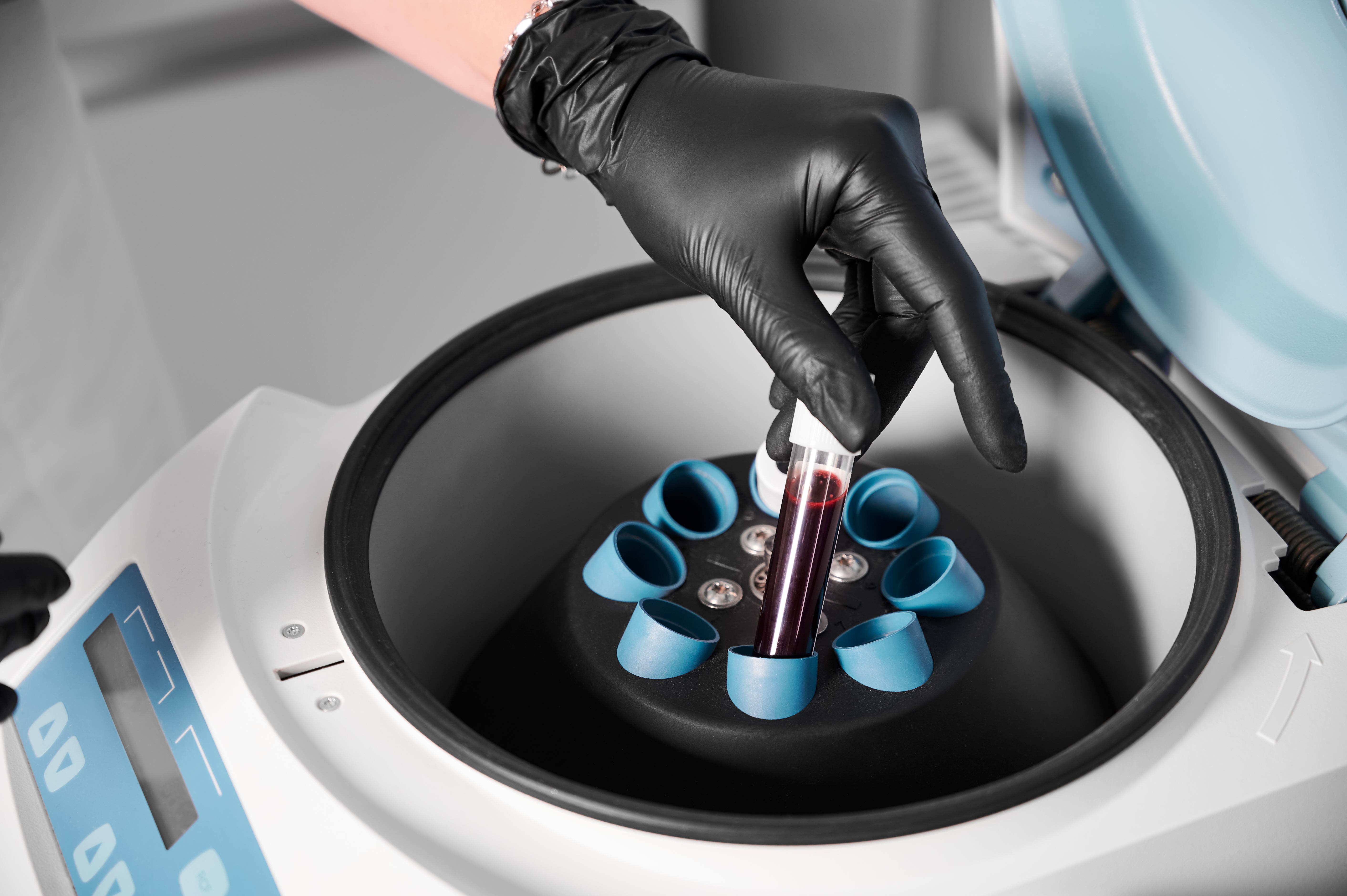
After collection, the blood sample is placed into a dedicated centrifugation system.
Centrifugation uses centrifugal force to separate blood components according to their physical properties.
After processing, the components form different layers, allowing the required plasma fraction to be collected according to the preparation protocol.
The key is not simply “the faster the centrifuge, the better.”
Speed, time and processing conditions should be appropriate for the specific collection system and intended PRP preparation method.
5. PRP Quality Is Not Determined by Blood Volume Alone
Some clients may assume:
“The more blood collected, the more PRP I will get.”
It is more complicated than that.
The final preparation can depend on:
- Individual blood characteristics.
- The collection kit.
- Collection technique.
- Processing conditions.
- Centrifugation settings.
- The method used to collect the desired plasma fraction.
Therefore, clients should look at the entire preparation process, not simply the volume of blood collected.
6. A Controlled Workflow Helps Support Safety
A professional PRP process can be organized into clear stages:
Step 1 – Preparation
The client is assessed and the required equipment is prepared.
Step 2 – Blood collection
Appropriate single-use collection supplies are used.
Step 3 – Sample processing
The blood sample is transferred into the appropriate processing system.
Step 4 – Centrifugation
The sample is centrifuged according to the relevant protocol.
Step 5 – PRP collection
The required plasma fraction is collected.
Step 6 – Preparation for treatment
The prepared sample is handled according to the doctor’s treatment plan.
Throughout the workflow, unnecessary exposure of the sample should be minimized.
PRP Safety Is More Than the Collection Kit
A good kit is important, but it is not the only factor determining safety.
A professional PRP procedure also depends on:
The practitioner + equipment + hygiene + blood collection + sample handling + centrifugation + infection control.
This is why clients should ask more than:
“Which PRP kit do you use?”
It is also reasonable to ask:
- Who performs the procedure?
- Are disposable needles used?
- How is the blood collected?
- How is the sample processed?
- What centrifugation system is used?
- How is infection control maintained?
What Makes Oceania’s PRP Approach Different?
Oceania Spa & Clinic presents PRP as a treatment using platelet-rich plasma prepared from the client’s own blood. Its Ho Chi Minh City clinic specifically emphasizes doctor-led procedures, with treatments performed by doctors rather than technicians.
Doctor-led procedures
This is particularly relevant for procedures involving blood collection and skin intervention.
Assessment before treatment
Oceania’s approach starts with understanding the client’s condition and goals before selecting a treatment rather than automatically recommending the same procedure to everyone.
Professional technology and international standards
Oceania presents a range of medical-grade aesthetic technologies and equipment associated with international certification standards appropriate to each system.
For FDA, clients should verify the specific clearance/certification for the exact device/model and intended use rather than relying solely on the technology name.
Transparent recommendations
Oceania emphasizes honest recommendations, including telling clients when a particular treatment may not be appropriate.
What Should You Check Before Having PRP?
Before choosing a PRP clinic in Vietnam, consider checking:
- Practitioner: Is the procedure performed by a doctor?
- Supplies: Are needles and disposable materials dedicated to each client?
- Collection kit: Is the kit appropriate and clearly sourced?
- Centrifuge: Is a dedicated centrifugation system used?
- Hygiene: Is the blood collection and processing workflow properly controlled?
- Consultation: Is your condition assessed before treatment?
A reputable clinic should be willing to explain these points before you proceed.
FAQ – PRP Preparation
Where does PRP come from?
PRP is prepared from the client’s own blood. Oceania also describes its PRP treatments as using platelet-rich plasma prepared from the client’s blood.
Are blood collection needles reused?
Blood collection needles should be single-use and disposed of appropriately after use.
Why is centrifugation necessary?
Centrifugation separates blood components so that the desired plasma fraction can be collected according to the PRP preparation protocol.
Does PRP need a completely sterile environment?
In clinical practice, the important goal is appropriate hygiene and infection control throughout the procedure. “Completely sterile” should not be interpreted as meaning that the entire surrounding environment contains absolutely no microorganisms.
Should a doctor perform PRP?
For procedures involving blood collection and skin intervention, an appropriately qualified medical professional is an important safety consideration. Oceania’s Ho Chi Minh City clinic states that procedures are performed by doctors rather than technicians.
PRP Safety Starts With the Process
When choosing PRP, do not only ask:
“What can PRP do?”
Start with a more fundamental question:
“How is the PRP collected and prepared?”
A trustworthy process should control the entire workflow—from collection kit and single-use needles to hygiene, sample handling, centrifugation and the practitioner performing the procedure.
At Oceania Spa & Clinic, PRP is offered within a doctor-led care model, with doctors directly performing procedures and assessing clients before treatment selection.
Learn more about PRP and treatments at Oceania:
🌐 Oceania Spa & Clinic
🌐 Oceania Spa & Clinic – Ha Noi
📍 Oceania Ha Noi: 60 Tuệ Tĩnh Street, Hai Bà Trưng Ward, Hanoi, Vietnam
📞 Ho Chi Minh Hotline: (+84) 96 151 6666
Oceania Spa & Clinic – Doctor-led procedures, controlled protocols, professional technology and a safety-focused approach.