


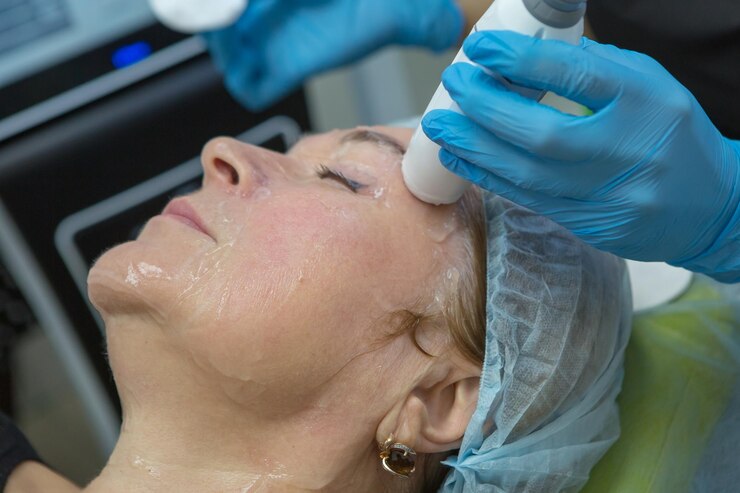
“Can HIFU burn the skin?” and “Can HIFU cause facial paralysis?” are common concerns for people considering non-surgical facial lifting.
HIFU uses focused ultrasound energy to target selected tissue layers beneath the skin. Controlled heat is generated at the focal point to support tissue tightening and gradual collagen remodeling.
However, HIFU is not completely risk-free.
When the device, cartridge, treatment depth or energy settings are inappropriate, energy may reach tissues that were not intended to be treated.
HIFU safety therefore depends on the right device, the right cartridge, the right depth, appropriate energy and qualified treatment planning.
Contents
1. Why Can HIFU Cause Burns or Nerve-Related Symptoms?
Not every device marketed as “HIFU” offers the same level of energy control.
With unverified equipment, it may be difficult to determine whether energy output remains stable or whether the ultrasound is focusing where intended.
The cartridge is equally important because it determines the depth at which energy is concentrated. A cartridge that is deteriorated or not appropriately managed may make energy delivery less predictable.
Facial anatomy also varies significantly between the forehead, temples, cheeks, jawline and submental area.
Using an unsuitable depth, repeatedly overlapping energy or treating the wrong anatomical area may expose tissues that were not intended to receive concentrated heat.
Rare reactions may include temporary numbness, altered sensation, unusual tingling, muscle weakness or thermal injury.
This is very different from suggesting that permanent facial paralysis is a routine result of HIFU.
More energy does not automatically mean better lifting. Correct tissue depth matters more than maximum intensity.
2. How Can HIFU Risks Be Reduced?
A properly planned HIFU treatment should begin with facial assessment rather than a predetermined shot count.
The physician evaluates:
- Degree of skin laxity.
- Soft-tissue thickness.
- Facial fat distribution.
- Jawline structure.
- Submental anatomy.
- Areas with limited soft tissue.
- Previous fillers, thread lifts or aesthetic procedures.
The treatment plan can then be adapted accordingly.
Different cartridges are selected for different depths. Treatment areas should also be mapped according to anatomy rather than covering the entire face uniformly.
Energy should be appropriate for the tissue being treated instead of simply being increased to create a stronger immediate sensation.
Unnecessary overlapping should also be avoided because repeated treatment in one location may increase heat accumulation.
Patient feedback matters as well. Severe sharp pain, excessive burning or electrical sensations should prompt reassessment rather than simply continuing treatment.
3. What Makes HIFU at Oceania Different?
At Oceania Spa & Clinic, HIFU is not performed using one standard setting for every face.
Physician-led facial assessment
Before treatment, the physician assesses facial anatomy and identifies the areas that genuinely require lifting.
Two patients with similar cheek laxity may differ considerably in soft-tissue volume, fat thickness, bone structure and previous aesthetic treatments.
These differences guide cartridge selection, treatment depth, energy and treatment mapping.
Sonorama HIFU with multiple treatment depths
Oceania uses Sonorama HIFU within its facial lifting protocols.
The system combines Standard and Pen Type handpieces and provides multiple treatment depths, allowing the physician to adapt treatment to different areas of the face rather than relying on one depth for every region.
FDA, KFDA and CE Certifications for Sonorama
The Sonorama system is presented with device-specific FDA, KFDA and CE certifications:
- FDA – United States: associated with U.S. Food and Drug Administration regulatory standards.
- KFDA – South Korea: associated with Korean regulatory standards.
- CE – Europe: indicates conformity with applicable European requirements.
These certifications provide greater transparency regarding the standards associated with the specific device being used.
They should not, however, be interpreted as a guarantee that HIFU can never cause an adverse effect. Appropriate patient assessment, cartridge selection, treatment depth and energy remain essential.
Shot count is not the only measure of treatment quality
More shots do not automatically mean better HIFU.
At Oceania, treatment lines are adjusted according to facial anatomy, treatment area and individual lifting goals.
Two patients receiving full-face HIFU may therefore require different shot counts, cartridges, depths and energy settings.
No aggressive treatment simply for an immediate lift
HIFU results continue to develop as tissue and collagen remodeling take place after treatment.
The aim is therefore not to produce the strongest possible immediate tightening effect, but to balance:
Lifting goals – facial anatomy – soft-tissue volume – skin response.
Conclusion
HIFU is not a treatment that routinely causes skin burns or facial paralysis, but it should not be presented as completely risk-free.
Unverified equipment, poorly managed cartridges, inappropriate energy and incorrect treatment depth may all increase the risk of unwanted effects.
Before choosing HIFU, look beyond the number of shots.
Ask:
Which HIFU system will be used? What certifications does that specific device have? Which cartridge will be selected? Who assesses my facial anatomy, and at what depth will the treatment be performed?
At Oceania Spa & Clinic, HIFU treatment uses the Sonorama system with FDA, KFDA and CE certifications, combined with physician-led facial assessment and an individualized treatment plan.