


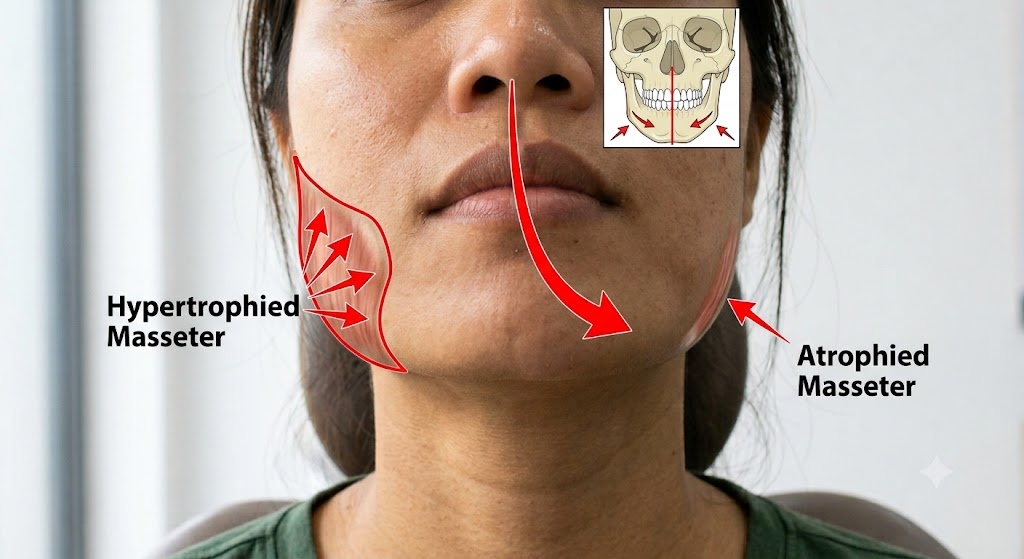
If one side of your jaw looks wider, or one masseter becomes noticeably more prominent when you clench, the asymmetry may partly be related to uneven masseter muscle development.
Habitually chewing on one side can make that side work harder over time.
However, an uneven jawline is not always a muscle problem. Bone structure, bite alignment, soft-tissue distribution and skin laxity can also affect lower-face symmetry.
That distinction determines whether a non-surgical treatment is likely to help.
Contents
1. How Can One-Sided Chewing Affect the Masseter?
The masseter is one of the main muscles involved in biting and chewing.
When one side consistently does more work, that muscle may become more developed than the other. Similar patterns may also be associated with frequent clenching, grinding or regularly chewing very tough foods.
Signs may include:
- One jaw angle appearing wider.
- A more prominent muscle bulge on one side when clenching.
- Uneven lower-face width.
- Greater asymmetry when viewed from the front.
But muscle size is only one possible factor.
If the asymmetry is mainly caused by the jawbone or dental bite, relaxing the masseter will not reposition the underlying structure. If the difference comes from loose skin or soft tissue, the treatment strategy will also be different.
The physician therefore needs to determine whether the asymmetry is muscular, structural or a combination of both.
2. Can Masseter Botox Improve Jawline Asymmetry?
When uneven masseter hypertrophy is the main cause, botulinum toxin type A may be considered.
The treatment reduces activity in the selected muscle. As an overactive or enlarged masseter becomes less dominant, the jaw angle may gradually appear softer and more balanced.
Importantly, facial asymmetry does not necessarily call for identical treatment on both sides.
The physician considers muscle size, contraction strength, facial proportions and the contribution of bone and soft tissue before planning treatment.
Can HIFU replace masseter Botox?
No. They address different targets.
Botulinum toxin is used to reduce activity in the masseter muscle.
HIFU belongs to a different category of treatment, focusing on tissue tightening and facial contour support. It may be considered when masseter asymmetry is accompanied by lower-face laxity or reduced jawline definition, but it does not replace muscle-focused treatment.
3. Jawline Balancing at Oceania: Treating the Cause Rather Than Treating Both Sides the Same
At Oceania Spa & Clinic, the first step is to determine what is creating the visible imbalance.
The physician assesses masseter activity at rest and during clenching, while also looking at bone structure, soft tissue, skin firmness and habits such as unilateral chewing, clenching or grinding.
When the asymmetry is predominantly muscular, botulinum toxin type A may be considered according to the condition of each side.
If lower-face laxity is also present, lifting technology may be evaluated separately.
Sonorama HIFU when additional jawline tightening is appropriate
Oceania uses Sonorama HIFU within selected facial lifting protocols. Its multiple treatment depths allow the physician to adapt treatment according to the tissue being targeted rather than applying one standard setting across the entire jawline.
Sonorama HIFU carries FDA, KFDA and CE certifications, reflecting regulatory and quality standards associated with the United States, South Korea and Europe. These device standards add transparency around the technology being used, but they do not replace physician assessment, correct depth selection or individualized treatment parameters.
Treatment response is then reviewed before further steps are considered.
The aim is not to make both sides of the face mathematically identical. Mild asymmetry is a normal feature of most faces.
The goal is to reduce noticeable imbalance and create a more harmonious lower-face contour while preserving the patient’s natural facial character.
Conclusion
One-sided chewing may contribute to uneven masseter development, but jawline asymmetry can also come from bone structure, bite or soft tissue.
When the masseter is the main factor, botulinum toxin type A may be considered. When lower-face laxity is also present, Sonorama HIFU may be assessed as an additional treatment rather than a substitute for muscle treatment.
At Oceania Spa & Clinic, the treatment plan begins by identifying whether the imbalance comes from muscle, structure or soft tissue before selecting the appropriate approach for each side of the face.